My Daughter’s Fever Climbed So High I Knew We Could Not Wait. But My Mother-In-Law Stood In The Kitchen And Told Me To Stay, Smile, And Cook For Her Guests. “Stop Embarrassing This Family,”
The Rising Heat
The digital thermometer beeped, a sharp, piercing sound that echoed in the quiet of my four-year-old daughter’s bedroom. I pulled it from Lily’s ear and stared at the glowing red numbers.
104.3°F.
My heart plummeted into my stomach. Lily was lying on her small bed, her skin flushed and radiating an unnatural, terrifying heat. Her chest rose and fell in rapid, shallow pants, and when I softly called her name, her eyelids barely fluttered. She was completely lethargic, her tiny fingers hot and limp within my grasp. This was not a common cold. This was an emergency.
Downstairs, the house was a symphony of clinking crystal, jazz music, and loud, booming laughter.
My mother-in-law, Beatrice, was hosting a massive, high-stakes dinner party for my husband’s senior partners at his law firm. For the past three days, I had been commanded to play the role of the perfect, obedient housewife. I had polished the silver, vacuumed the Persian rugs, and spent the last eight hours in the kitchen preparing a flawless, five-course French menu.
My husband, Richard, had barely looked at me all evening. He was too busy pouring expensive scotch and laughing at his boss’s jokes, completely absorbed in his own ambition.
I scooped Lily up into my arms. She felt like a burning furnace. I grabbed her favorite blanket, wrapped it tightly around her shivering body, and hurried out of the nursery. I didn’t care about the dinner party. I didn’t care about the perfectly timed beef wellington resting in the oven. My only priority was getting my child to the emergency room before her little body gave out.
The Kitchen Confrontation
I practically ran down the back staircase, bypassing the formal living room to slip directly into the massive chef’s kitchen. My purse and car keys were resting on the marble island.
As I reached for my keys, the swinging kitchen door pushed open.
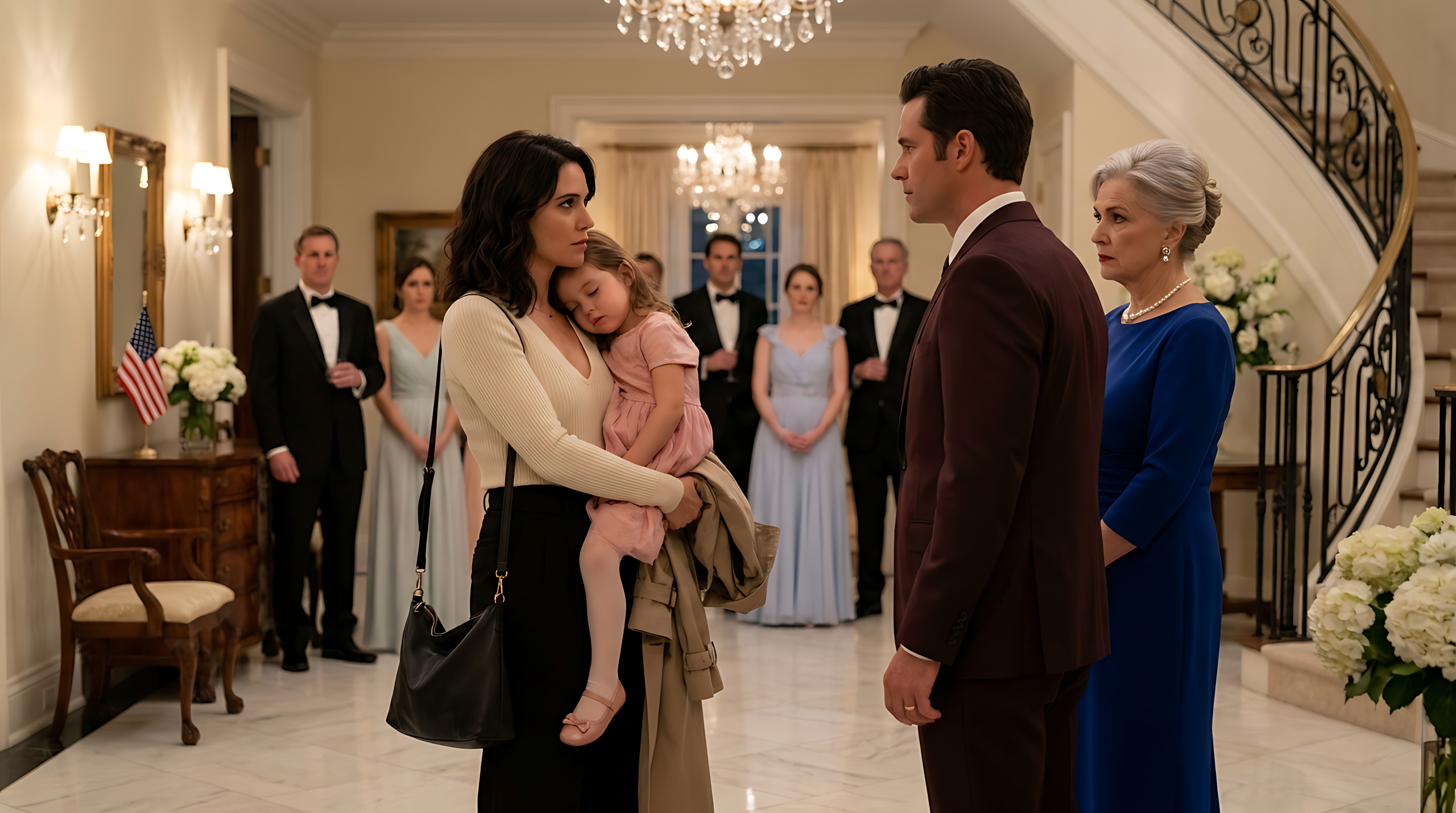
Beatrice walked in, holding an empty silver platter. She was wearing a custom-tailored emerald gown, her hair perfectly coiffed, and her face set in a permanent expression of aristocratic judgment. When she saw me standing there in my stained apron, holding a bundled, sweating child and my car keys, her eyes narrowed into dark slits.
“What on earth are you doing, Clara?” Beatrice snapped in a harsh, hushed whisper, completely ignoring the fact that her granddaughter was unconscious in my arms. “The guests are finishing their salads. You need to slice the wellington and begin plating the main course immediately.”
“Lily is burning up, Beatrice,” I said, my voice trembling with panic as I adjusted the heavy weight of my daughter. “Her fever is over 104 degrees. She isn’t responding. I have to take her to the hospital right now.”
Beatrice rolled her eyes, letting out a dramatic, irritated sigh. She stepped squarely in front of the door leading to the garage, blocking my exit.
“She just has a little bug. Give her some children’s Tylenol and put her back to bed,” Beatrice commanded, waving her hand dismissively. “Do you have any idea how important these people are? Richard’s promotion is entirely dependent on tonight going flawlessly. You cannot leave the kitchen in the middle of a five-course meal.”
“I am not asking for your permission,” I said, my voice hardening. “Move out of my way.”
Beatrice didn’t budge. She crossed her arms, her face contorting into an ugly mask of pure vanity and cruelty. She leaned forward, her voice dripping with venom.
“My daughter’s fever climbed so high I knew we could not wait. But my mother-in-law stood in the kitchen and told me to stay, smile, and cook for her guests. ‘Stop embarrassing this family,’” she hissed. “Put the child upstairs, wash your face, and do your job as a wife.”
The Breaking Point
For six years, I had swallowed my pride. I had endured her passive-aggressive insults, her relentless demands, and her complete lack of empathy, all to keep the peace for my husband.
But looking down at my sweet, helpless daughter, whose breathing was becoming dangerously shallow, the final thread of my tolerance permanently snapped.
I didn’t argue with her. I didn’t scream or throw a pan across the room. I simply walked directly toward her, my eyes locked onto hers with a cold, terrifying absolute certainty.
“If you do not step aside this exact second,” I said, my voice dropping to a lethal, deadly whisper, “I will walk out into that dining room, interrupt Richard’s boss, and scream for an ambulance. I will make sure every single person in this city knows exactly what kind of monsters live in this house.”
Beatrice’s eyes widened. She saw the primal, unhinged protective fire of a mother in my eyes, and for the first time in her life, she shrank back. She took a step away from the garage door.
I pushed past her without another word, kicked the heavy fire door open, and strapped Lily into her car seat.
The Red Lights
I drove like a madwoman. I ran three red lights, my hazard flashers blinking wildly in the dark night. I kept one hand on the steering wheel and the other reaching back to stroke Lily’s burning cheek, praying into the empty car for her to just hold on.
When I slammed the brakes outside the emergency room sliding doors, I didn’t bother parking in a designated spot. I ripped Lily out of her seat and sprinted through the automatic doors, screaming for help.
The triage nurses saw the color of my daughter’s skin and bypassed the waiting room entirely. They rushed us into a trauma bay.
The next three hours were a terrifying blur of IV lines, ice packs, and frantic doctors. They discovered that Lily had developed a severe, aggressive bacterial infection in her bloodstream that had spiked her fever to the point of inducing silent febrile seizures.
The attending pediatrician looked at me with grave, sympathetic eyes. “You got her here just in time,” he told me quietly. “If you had waited even another hour, the fever would have caused permanent neurological damage. Or worse.”
I collapsed into the plastic hospital chair, burying my face in my hands, sobbing violently as the adrenaline finally left my body.
The Late Arrival
It was nearly two in the morning when the doors to the pediatric ward swung open.
Richard marched into the room. He was still wearing his expensive tuxedo, but his face was flushed with anger. He didn’t rush to his daughter’s bedside. He didn’t pull me into his arms to comfort me.
“Do you have any idea what you did tonight?!” Richard whisper-shouted, pointing a finger at me. “You abandoned my mother in the kitchen! The wellington burned! The dessert was ruined! My boss left early because the entire evening was a chaotic disaster! You completely humiliated us!”
I sat in the chair, watching my husband prioritize a piece of roasted meat over the life of his own child.
“Lily almost died tonight, Richard,” I said, my voice completely devoid of emotion.
Richard paused, glancing at the IV tubes connected to Lily’s tiny arm, but his arrogance quickly overpowered his guilt. “Well, she’s fine now, isn’t she? You always overreact. You could have just waited until the dinner was over. You ruined my career.”
I stood up. I walked over to the man I had promised to spend my life with, and I looked at him as if he were a complete stranger.
“No, Richard,” I said softly, the absolute clarity of my decision washing over me like a cold wave. “I didn’t ruin your career. I saved my daughter’s life. And as of tonight, I am ruining your marriage.”
The Morning Light
I didn’t go back to the house. I stayed in the hospital room with Lily for three days until her fever finally broke and she was cleared to go home.
But “home” was no longer a mansion filled with crystal glasses and cold hearts. While I was in the hospital, I called my sister, who lived two states away. She drove through the night, went to Richard’s house while he was at work, packed everything Lily and I owned, and brought it to the hospital.
When Lily was discharged, I walked out into the bright morning sunlight, strapped her into my sister’s car, and drove away from that family forever.
Richard and Beatrice tried to call. They tried to threaten me with legal action, claiming I had no right to leave. But when my divorce attorney presented them with the hospital records—proving they had attempted to deny emergency medical care to a dying child in order to serve a dinner party—they went completely, utterly silent.
I traded the Persian rugs and the five-course meals for a small, quiet apartment where my daughter could laugh, play, and be fiercely, unconditionally loved. They thought my departure was an embarrassment to their family. But leaving them was the proudest thing I have ever done.