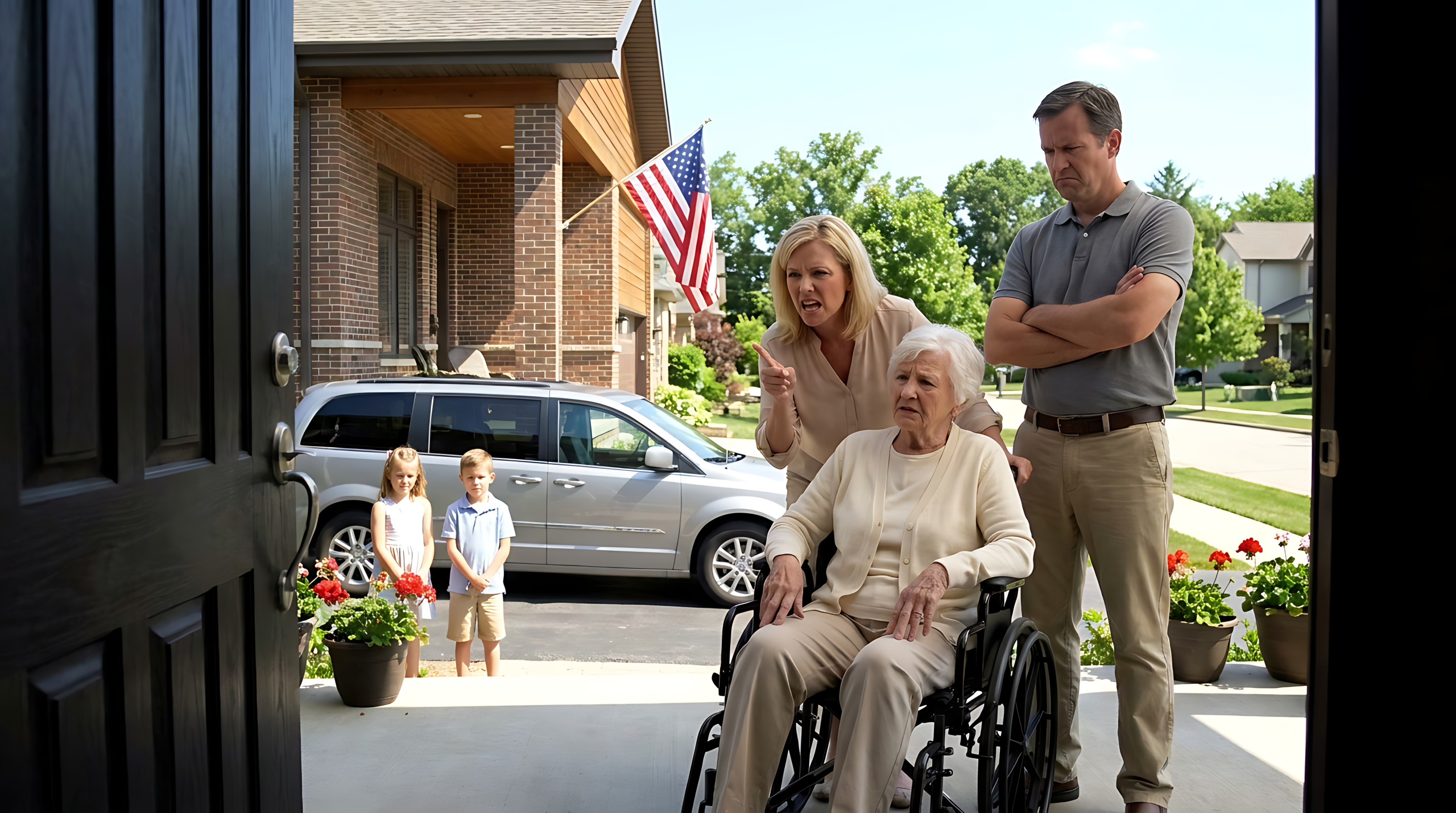
I arrived at my son’s home in a wheelchair and pleaded for somewhere to live, but he shut the door as though I were a stranger. The following morning, I took an old card belonging to my late husband from a forgotten drawer and brought it to the bank. The manager examined it, shot to his feet so quickly his chair crashed backward, and whispered, “Ma’am… there’s something you need to see.”
The Ultimate Rejection
The rain was coming down in freezing, slanted sheets the night I lost everything.
At seventy-two years old, after a series of brutal medical bills and a predatory eviction, I found myself sitting in a battered wheelchair on the pristine front porch of my only son’s suburban mansion. My husband, Arthur, had passed away a decade prior, leaving me with what I thought was just enough to scrape by. But life has a way of wearing down even the strongest foundations.
I knocked on the heavy oak door, my hands trembling from the cold.
When the door swung open, my son, Robert, stood there in a tailored suit, holding a crystal glass of bourbon. Behind him, the warm glow of a chandelier illuminated a house full of laughing, wealthy guests.
Robert looked down at me, his eyes sweeping over my soaked coat and my wheelchair. There was no shock. There was no pity. There was only profound irritation.
“Robert, please,” I whispered, my voice breaking. “I have nowhere else to go. The landlord locked me out. I just need a place to sleep… just for a little while.”
His wife, Elise, stepped up behind him. She whispered something in his ear, her face twisting in disgust. Robert sighed, a cold, calculated sound.
“Mom, you can’t be here,” Robert said, keeping his voice low so his guests wouldn’t hear. “We are hosting an incredibly important networking dinner. You’re completely soaking wet, and frankly, we don’t have the space or the time to accommodate your medical needs. I’ll have my assistant call a social worker for you on Monday.”
“Robert… I’m your mother,” I pleaded, tears mixing with the rain on my cheeks.
“I can’t do this right now. Goodbye, Mom,” he said smoothly.
He stepped back and shut the heavy door directly in my face, the definitive click of the deadbolt locking me out in the freezing dark. He looked at me as though I were a panhandler on the street, completely erasing decades of a mother’s sacrifice in a single heartbeat.
The Forgotten Relic
I spent that night in the lobby of a nearby 24-hour bus terminal, wrapped in a foil emergency blanket a kind security guard had handed me. As the hours ticked by, the crushing sorrow of my son’s betrayal morphed into a quiet, hollow numbness.
When morning broke, I realized I had exactly one possession left in the world that wasn’t currently locked inside my repossessed apartment. It was a small, locked mahogany box that I always kept in the bottom of my purse. It had belonged to Arthur. He had handed it to me on his deathbed, his breathing shallow, and told me, “Only open this when you have absolutely no other doors left to walk through.”
I had never opened it, largely out of sentimental respect. But sitting in that cold bus station, entirely abandoned, I realized I had finally run out of doors.
I used the edge of a heavy metal zipper on my bag to pry the small brass lock open.
Inside the velvet-lined box, there was no cash. There were no jewels. There was only a single, heavy card. It wasn’t plastic. It was forged from solid, matte-black titanium, edged in gold. There were no account numbers on it, and no expiration date. The only things etched into the metal were the crest of the oldest, most prestigious private bank in the city, and my late husband’s name: Arthur Vance.
With nothing left to lose, I rolled my wheelchair out of the station and caught a city bus toward the financial district.
The Bank Manager’s Panic
The grand lobby of Sterling & Hayes National Bank was a temple of marble and quiet wealth. I felt entirely out of place in my damp, wrinkled clothes, pushing my squeaky wheelchair across the polished floors.
I approached a young, immaculately dressed teller. When I handed her the heavy black metal card, she frowned, turning it over in her hands.
“Ma’am, I’m not sure what this is,” the teller said dismissively. “Is it some sort of novelty item? We only process standard account cards here.”
“My husband told me it was important,” I insisted quietly. “Could you please just scan it? Or ask someone?”
Rolling her eyes, she swiped the thick metal through an older, specialized card reader at the side of her terminal. The machine beeped, and a red error message flashed on her screen. She sighed and picked up her desk phone. “Mr. Caldwell? I have an elderly woman here with a strange piece of metal. The system is throwing an override code.”
Two minutes later, the branch manager, Mr. Caldwell—a stern man in a three-piece suit—walked out of his glass-walled office. He looked highly annoyed to be interrupted. He walked over to the teller’s station and glanced down at the black card resting on the counter.
Mr. Caldwell froze.
He leaned in closer, his eyes wide, completely ignoring me and the teller. He typed a sequence of override commands into the terminal.
The moment the screen refreshed, all the blood instantly vanished from Mr. Caldwell’s face.
He shot to his feet so quickly that his heavy leather office chair crashed backward onto the marble floor. The loud bang echoed through the entire bank, causing customers and security guards to turn their heads in alarm.
Mr. Caldwell didn’t care. He was hyperventilating, his hands trembling as he stared at the screen. He slowly turned his head to look at me, his arrogant demeanor completely vaporized, replaced by sheer, absolute awe.
“Ma’am…” he whispered, his voice shaking. “There’s something you need to see. Please. Come with me right now.”
The Absolute Revelation
He bypassed the teller, hurried out into the lobby, and personally took the handles of my wheelchair. He bypassed his own office and wheeled me directly toward the heavy, steel vault doors at the back of the building, flanked by armed guards. He swiped his own security badge, and we entered a lavish, private viewing room reserved only for the ultra-wealthy.
He locked the door behind us, walked over to a secure terminal, and turned the massive monitor to face me.
“Mrs. Vance,” Mr. Caldwell stammered, pulling a silk handkerchief from his pocket to wipe the sweat from his forehead. “I have worked at this institution for thirty years, and I have never seen a Black Founders Card in person. They were issued forty years ago to the original, silent venture capitalists who funded the technological boom of this city.”
I stared at him in confusion. “Arthur was a mechanical engineer. He worked long hours, but we lived modestly. We were never wealthy.”
“Your husband was a genius who valued privacy above all else,” Mr. Caldwell corrected me, his voice filled with reverence. “Forty years ago, he quietly patented a proprietary cooling mechanism used in early server farms. He sold the patent for stock, not cash. He placed those shares into a dormant, compounding trust attached to this metal card, instructing us never to contact you until you brought the card through our doors.”
He pointed a shaking finger at the bottom of the digital ledger on the screen.
“Mrs. Vance, over the last forty years, those tech stocks have split and compounded exponentially,” Mr. Caldwell explained. “After taxes, the liquid cash value of this account is currently sitting at… four hundred and eighty-two million dollars.”
The silence in the room was deafening. I looked at the string of numbers on the screen, completely unable to comprehend it. I had been begging for a place to sleep the night before. Today, I owned half the bank.
“Would you… would you like me to arrange a private car? A hotel suite?” Mr. Caldwell asked desperately, eager to please a woman who could buy his entire career with a single signature.
“Yes,” I breathed, sitting a little taller in my chair. “A very nice hotel, Mr. Caldwell. And then, I need you to find me a real estate attorney.”
The Turning of the Tide
Within a week, my life had entirely transformed.
I purchased a stunning, sprawling beachfront estate with a wrap-around veranda and an elevator for my chair. I hired a private chef, a dedicated team of physical therapists, and a wonderful live-in nurse named Sarah, who treated me with more kindness than my own son ever had. I established charitable foundations for the elderly and donated millions to the shelter networks in the city.
I never called Robert. I didn’t need to.
Six months later, the truth finally reached him. The financial circles in the city had begun whispering about the mysterious widow who was quietly buying up commercial real estate and making massive philanthropic waves. It didn’t take long for Robert, a desperate corporate climber, to realize that the billionaire everyone was talking about was the mother he had thrown into the rain.
He showed up at my estate on a sunny Tuesday afternoon.
I was sitting on the veranda, enjoying a cup of tea and looking out at the ocean, when my private security team escorted Robert to the patio. He was carrying a massive bouquet of expensive flowers, wearing his most charming, repentant smile.
“Mom!” Robert beamed, rushing forward as if the last six months had never happened. “My god, look at this place! You look wonderful! Why didn’t you tell me? I was so worried about you when I couldn’t reach the social workers!”
I set my teacup down. I looked at the man I had given birth to, feeling absolutely nothing.
“You weren’t worried, Robert. You were inconvenienced,” I said, my voice perfectly calm and steady.
His smile faltered slightly. “Mom, please. That night… Elise and I were under so much stress. We made a terrible mistake, and I have regretted it every single day. I came here to apologize. And to ask if you’d like to come over for dinner tonight. We want you back in our lives.”
He was looking at the veranda, at the tailored grounds, and at the sheer, undeniable wealth surrounding me. He wasn’t looking at his mother. He was looking at a bank account.
“You didn’t make a mistake, Robert. You made a choice,” I replied softly.
I gestured to the head of my security detail, a towering man in a dark suit.
“Mom, come on,” Robert pleaded, the panic starting to seep into his voice as the security guard stepped between us. “I’m your son! We’re family! You can’t just cut me out!”
“I am completely out of space, Robert. And frankly, I don’t have the time,” I said, using the exact words he had used to discard me in the freezing rain.
I turned my wheelchair around, facing the beautiful, glittering ocean.
“Goodbye, Robert,” I said over my shoulder.
I listened to his frantic, desperate apologies fade away as my security team escorted him off the property. The heavy wrought-iron gates of my estate clicked shut behind him, sealing him out of my life forever. I took a slow sip of my warm tea, finally at peace, knowing that the door Arthur had left for me was the only one I would ever need.